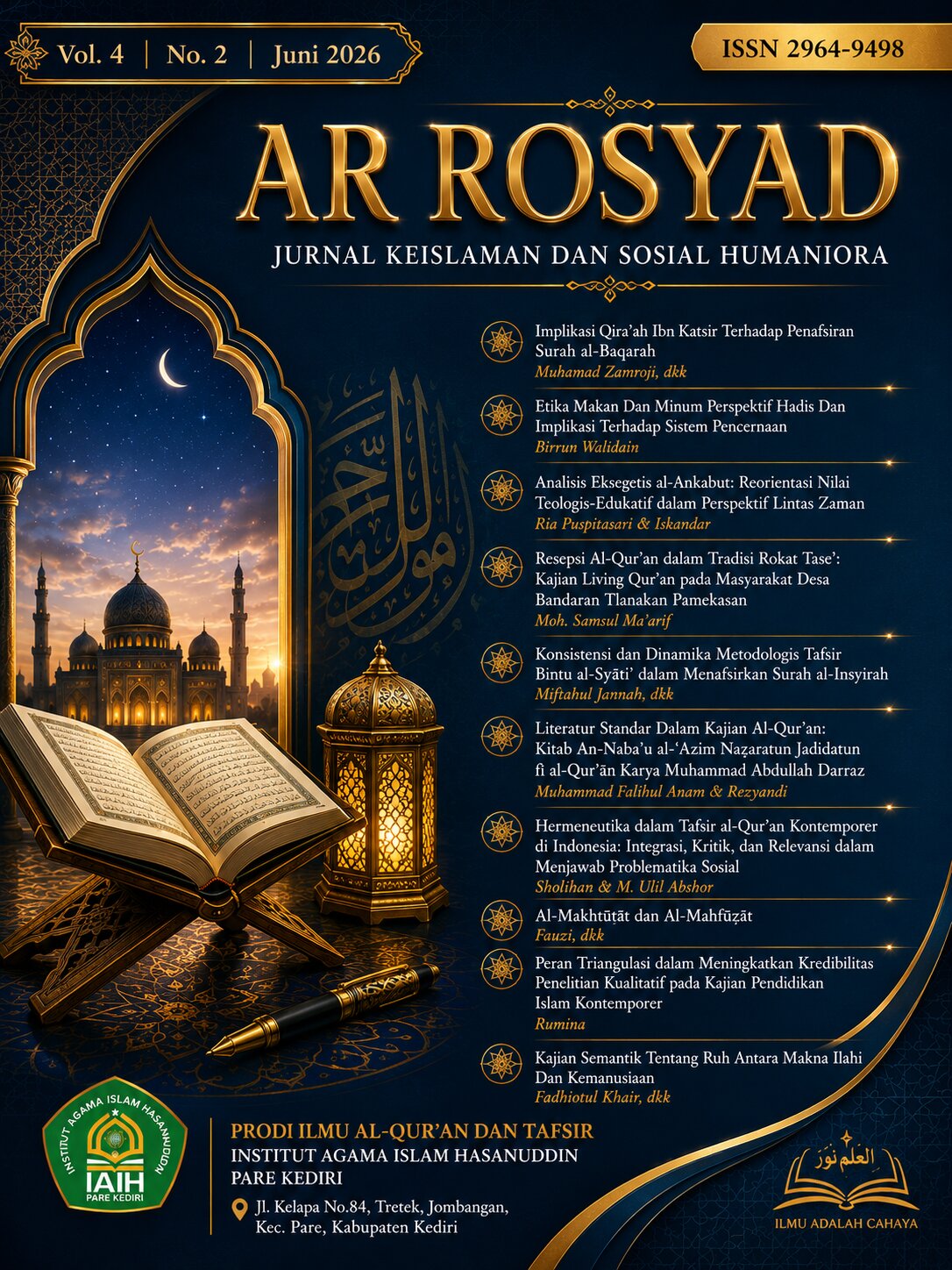
Analisis Eksegetis al-Ankabut: Reorientasi Nilai Teologis-Edukatif dalam Perspektif Lintas Zaman.
DOI:
https://doi.org/10.55148/8h85r941Abstract
This research analyzes the parable of the spider in Surah al-Ankabut verse 41, aiming to uncover its profound meanings, review the perspectives of exegetes across generations, and identify the theological-educational values embedded within it. Employing a library research method and a thematic interpretive approach (tafsir maudū’i), this study comprehensively collects and analyzes all relevant verses related to the spider theme. The findings indicate that the spider's parable, despite positive characteristics like independence and persistence, fundamentally highlights the extreme fragility of its web as a shelter. Interpretations from the Mutaqaddimin period (Ibn Abbas and Ibn Jarir al-Tabari) focused on the weakness of idols as objects of worship. Mutaakhkhirin exegetes (Ibn Kathir and Al-Razi) expanded the meaning of this parable to include the weakness of any reliance on other than Allah, even encompassing syirik khafiy (minor polytheism). Meanwhile, contemporary exegetes (Sayyid Qutb and Wahbah al-Zuhayli) contextualized this parable to human reliance on worldly powers such as government, wealth, and knowledge. Overall, this parable emphasizes the value of monotheism, Allah's authority and omnipotence, and the helplessness and fragility of created beings in the face of divine power. It serves as an eternal guide for humanity to rely solely on Allah.
References
Abī Ja‘far Muḥammad Ibn Jarīr al-Ṭabarī, Tafsīr al-Ṭabarī Jāmi’ al-Bayān ‘an Ta’wīl Āy alQur’ān, Jilid 18. Kairo: Badār Hijr, 2001.
Fayrūz Abadī, Tanwīr al-Miqbās min Tafsīr Ibn ‘Abbās. Beirut: Dar al-Kutub al-‗Ilmiyyah,
1992.
Hamka, Tafsir al-Azhar, Juz 20. Jakarta: PT. Pustaka Panjimas, 1982.
Ibn Manẓūr, Lisān Al-‘Arab. Beirut: Dar al-Ma‘arif, n.d.
Imād al-Dīn Abī al-Fidā‘ Ismā‘īl Ibn Katsīr al-Dimasyqī, Tafsīr al-Qur’ān al-‘Aẓim, Jilid 10. Kairo: Dar al-Kutub al-‗Ilmiyyah, 2000.
M. Quraish Shihab, Tafsir al-Mishbah: Kesan, Pesan dan Keserasian Alquran. Vol. 10. Jakarta: Lentera Hati, 2002.
M. Rusydi Khalid, ―Perumpamaan dalam Alquran (Amtsal Alquran),‖ Jurnal Adabiyah, 2, no. 1(2011).
Ma‘luf, Louis. Al-Munjid Fī Al-Lughah Wa Al-A’lām. Beirut: Dar al-Masyriq, 2007.
Mannā‘ al-Qaṭṭān, Pengantar Studi Ilmu Qur’an, Terj. H. Aunur Rafiq El-Mazni. Jakarta: Pustaka al-Kautsar, 2005.
Mannā‘ al-Qaṭṭān, Studi Ilmu-Ilmu Qur’an, Terj. Mudzakir. Bogor: Lentera Antar Nusa, 2009.
Mohd Sukki Othman. Zulkifli Mohd Yusoff, ―Perumpamaan Serangga Dalam Alquran: Analisis I‗Jaz,‖ Quranica: International Journal of Quranic Research, 2, no. 13 (2021)
Muḥammad ‗Ali Al-Ṣabūnī, Shafwatut Tafasir: Tafsir-tafsir Pilihan, Jilid 4, Terj. KH. Yasin. Jakarta: Pustaka Al-Kautsar, 2011.
Muḥammad al-Rāzī Fakhr Al-Dīn, Tafsīr al-Fakhr al-Rāzī, Juz 25. Beirut: Dār al-Fikr, 1981.
Rosihan Anwar, Ilmu Tafsir. Bandung: Pustaka Setia, 2005.
Sayyid Quṭb, Tafsir Fi Zhilalil Qur’an: Di Bawah Naungan Alquran, Jilid 9, Terj. As‘ad
Yasin, dkk. Jakarta: Gema Insani Press, 2004.
Wahbah Al-Zuhaylī, Al-Tafsīr al-Munīr. Beirut: Dār al-Fikr, 2009.
Yazid bin Abdul Qadir Jawas, Syarah ‘Aqidah Ahlus Sunnah Wal Jama’Ah. Bogor: Pustaka
Imam Syafi‘i, 2006.
Yusūf al-Hajj Ahmad, Ensiklopedi Kemukjizatan Ilmiah dalam Alqur’an dan Sunnah, Juz 6, Terj. Masturi Irham, dkk. Jakarta: PT. Kharisma Ilmu, n.d.
Downloads
Published
Issue
Section
License
Copyright (c) 2026 AR ROSYAD: Jurnal Keislaman dan Sosial Humaniora

This work is licensed under a Creative Commons Attribution-NonCommercial 4.0 International License.


