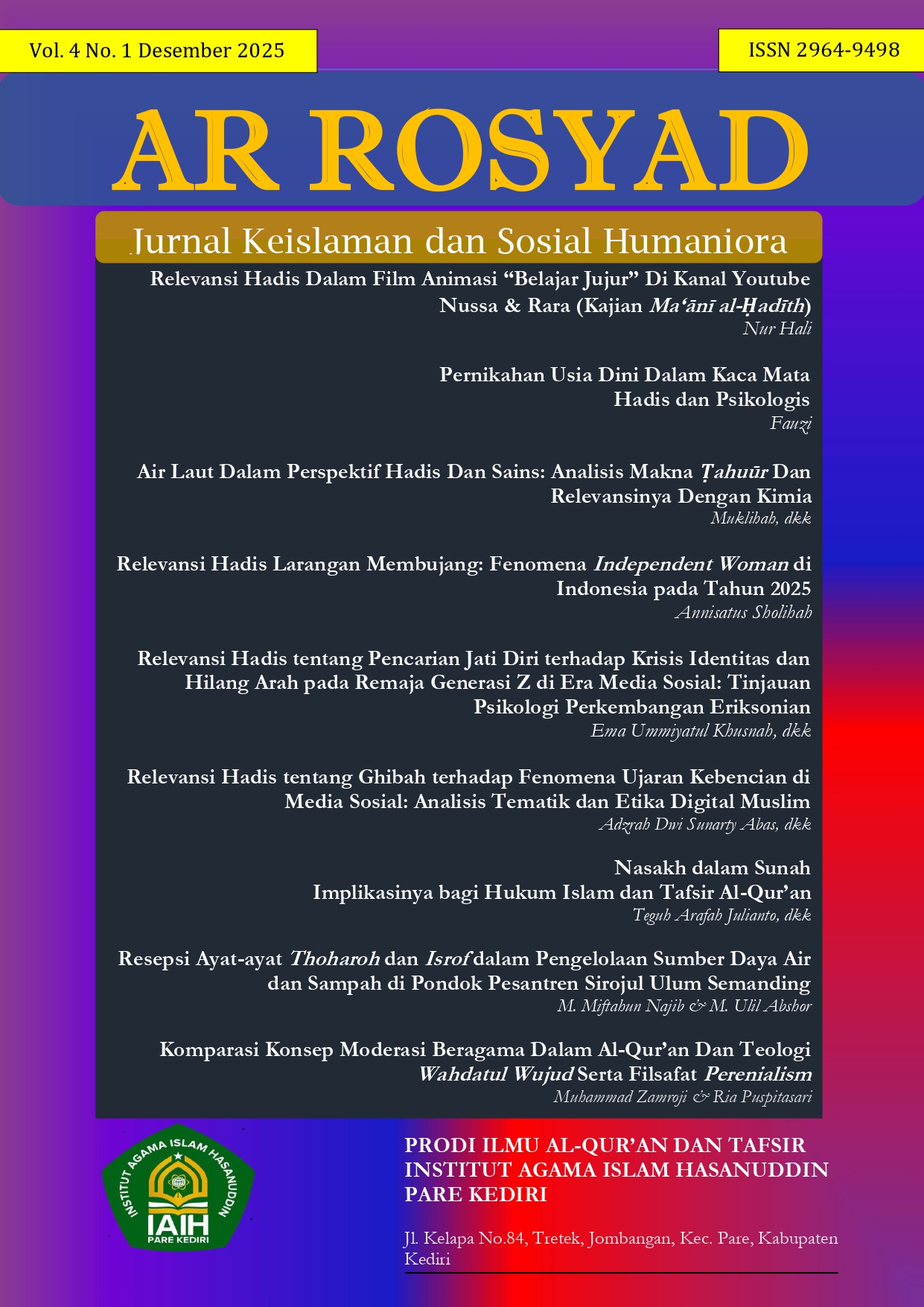
Relevansi Hadis tentang Pencarian Jati Diri terhadap Krisis Identitas dan Hilang Arah pada Remaja Generasi Z di Era Media Sosial: Tinjauan Psikologi Perkembangan Eriksonian
DOI:
https://doi.org/10.55148/n6e7za30Keywords:
Hadith, Identity Crisis, Generation Z, Ma‘rifat al-Nafs, Eriksonian PsychologyAbstract
The phenomenon of identity crisis and loss of direction among Generation Z adolescents has become increasingly concerning amid the dominance of social media. This study aims to analyze the relevance of the hadith on ma‘rifat al-nafs (“Whoever knows himself knows his Lord”) in relation to the psychological and spiritual problems faced by the digital generation from the perspective of Eriksonian developmental theory. The research employs a qualitative approach through a literature study of hadith scholarship, developmental psychology, and modern adolescent social phenomena. The findings reveal that Generation Z’s identity crisis arises from disconnection from spiritual values and the dominance of digital self-image. The hadith on ma‘rifat al-nafs offers a reflective paradigm that can restore spiritual and moral balance, while Erikson’s theory explains the psychosocial mechanisms of identity formation. The integration of these two perspectives produces a comprehensive approach to shaping adolescent identity that is both spiritually and socially grounded. This study emphasizes the importance of hadith-based Islamic education and counseling in addressing the existential disorientation of youth in the digital era.
References
Alhabsyi, Zulfi Farhan. “Prophetic Parenting : Strategi Mencegah Krisis Identitas Remaja Muslim Di Era Hiperrealitas” 6 (2025): 17–29. https://doi.org/10.21154/maalim.v6i1.10174.
Arwani, Muhammad. “THE RELEVANCE OF THE STORY OF ASHABUL KAHFI IN TAFSIR AL-MARAGHI AS A SOLUTION TO THE IDENTITY CRISIS OF THE MILLENNIAL GENERATION TAFSIR AL-MARAGHI SEBAGAI MILENIAL ةيولها ةمزلأ لحك غي ارلما يرسفت في فهكلا باحصأ ةصق ةقلاع ىدم ةيفللأا ليج ىلد” 9, no. 1 (2023): 108–35.
Asosiasi Penyelenggara Jasa Internet Indonesia (APJII). “Laporan Survei Internet Indonesia 2023.” Jakarta, 2023. https://apjii.or.id/content/read/104/650/Laporan-Survei-Internet-Indonesia-2023.
Farecy, N. D. A. “Dampak TikTok Terhadap Psikologis Remaja: Fenomenologi Pengguna Aktif Di SMAN 1 Luwu,” 2025.
Firdaus, Muhammad Riziq, Muhammad Izzul Haq, Fauzan Ananta Fahmi, Riky Supratama, and Muhammad Riziq Firdaus. “PERAN PENDIDIKAN AGAMA ISLAM DAN KESEHATAN MENTAL DI KALANGAN SISWA Corresponding Author : Muhammad Riziq Firdaus” 2, no. 1 (2025).
History, Article. “1 , 2 , 3” 6, no. 3 (2025): 453–67.
Kamaluddin, Ahmad. “Regulasi Emosi BerbasisAl-Quran Dan Implementasinya Pada Komunitas Punk Tasawuf Underground,” 2021.
Kamil, Haikal Hamdul. “Peran Konseling Islam Dalam Membantu Siswa Mengatasi Krisis Identitas Remaja Di Sekolah” 2, no. 1 (2025): 238–48.
Lathifah, Izzatuzzahro, Salwa, Meleza, Indah, Fitri. “Teori Perkembangan Bahasa, Psikososial, Dan Emosional Pada Anak: Ditinjau Dari Perspektif Pendidikan Islam” 10 (2025): 350–68.
Nur, F. H., & Aryati, A. “Pendekatan Psiko-Spiritual Dalam Pendidikan Agama Islam Untuk Mengatasi Krisis Identitas Remaja.” Jurnal Ilmu Pendidikan Islam, KOPERTAIS IV, 2025.
Putri Nur Aini, Qonita Elviana Bahiyah, Abdul Aziz. “AGAMA ISLAM DALAM MEMBANGUN PSIKOSOSIAL” 2, no. 1 (2025): 61–70.
Ramadhani, Putri Sari. “Analisis Faktor Krisis Identitas Pada Remaja Di Kecamatan Ujung Kota Parepare,” 2024.
Reinandini, Elvina, Siti Fatimah, and El Salim. “ISLAM TENTANG PENCARIAN JATI DIRI” 1, no. 3 (n.d.).
Sugiyono. Metodologi Penelitian Kuantitatif, Kualitatif Dan R & D, 2020.
Sumbulah, U., Kholil, A., & Nasrulloh. STUDI ALQUR’AN DAN HADIS. UIN-Maliki Press., n.d.
Zahrotunnisa, Zhahira, and Abdul Fadil. “Krisis Identitas Dan Tantangan Pendidikan Islam Di Era Digital : Analisis Perspektif Sosiologi Pendidikan” 3, no. 4 (2025).
Zulki, Ahmad. “Psikologi Sufi Era Industri 4.0 Perspektif Al-Quran,” 2022.
Downloads
Published
Issue
Section
License
Copyright (c) 2025 AR ROSYAD: Jurnal Keislaman dan Sosial Humaniora

This work is licensed under a Creative Commons Attribution-NonCommercial 4.0 International License.


